Sunday, March 22, 2009

Dans le merde

The rhythm in a bakery is very different. My busiest day is my first day back; Saturday, I'm taking it easy, doing some extra dishes, getting out early.

Not like the line.

Which doesn't mean you don't get weeded. You do. But this is Production in a different sense of the word. And our weeds are different. It's like a different part of the swamp.

What I hate, though, are the weeds you can see from a distance, the weeds you see coming, but you just haven't reached them yet. Knowing they are mostly unavoidable. It comes from being part of a good solid team. You would think that would make it better, right? A good team can pull together, pull through. A good team can weather the occasional outbreak of the plague or maternity leave. Yes, maternity leaves come in outbreaks. Seriously.

What a good team can't do easily, is hum smoothly along when parts of it leave permanently. Sometimes it happens, through no fault of management, economy, or Acts of God, that you lose a few people all at once. Rolling over a quarter of your production staff in a two month period? That's pretty harsh. We're dealing with that now.

And if you're a team of two, and your other half is leaving? The half that could be relied upon to pick up all those thousand little jobs which, although each was a five minute job, those five minutes added up to hours of every day? The half that knew exactly what you meant when you forgot English was your native language and gibbered about the thingy. The half that made you crazy with cleaning even as you were inspired to do better yourself. The half that let you bitch about a job you love just because you needed to bitch about something. The half that actually deserved full credit because you knew that, even if that person could not do your job, you would have problems doing your job without them? When that half leaves, even if you understand, are genuinely happy for their opportunity, and wish them all the best, how do you roll with that?

You see the weeds coming. But you know the old saying about lemons.

I'll miss you, other half. Big shoes.

Monday, March 2, 2009

Worldly Distractions

Things in the world suck right now. Talked to various family members about how much money they are no longer worth thanks to the market. The place where I live was named in Business Week as the U.S.'s most unhappy city. Another friend lost his job. I'm the only source of income in my house and we just paid rent. That cat puked on the stairs. We have new neighbors and they have a barky dog.

So, I made candy. All day.

Why did I make candy? Because I love doing it. Because it is relatively easy, requires little in the way of cash and equipment. Because there is a good effort to reward ratio. It's a skill I like to develop. There is inifinite chance to adapt, to play. I shelled and toasted my local hazelnuts for toffee. I threw some matcha in the cream for my chocolate caramels. I found inspiration for my hard candies in what I was drinking and the flavor defined the shape. I got excited with each new batch to try something more. When I looked up, I had used every silpat in the house but one, I had candy everywhere and hours had passed. And I realized, for a while, it had been ok.

I can't say we'll all be ok, I can't even say that it will get better. There may be some sort of deeper meaning to choosing lemon and bitters to flavor my hard candy, other than the fact that it tastes awesome.

Whatever the world brings, sugar is easy to clean up. Water just washes it away.

Saturday, February 21, 2009

10,000 Hours

That's the magic number, as far as brains are concerned.

Even before diving in to Outliers, I'd heard the number before. It goes something like this: in order to master something (and I mean You are the Shit, the Bee's Knees, recognized for what you can do) you need to practice it for ten thousand hours. That's when the brain flips a switch and says "Ok, this? We've got it." The difference between good and great isn't just practice. It's many, many hours of practice.

Ten thousand hours works out to be about eight hours a day, seven days a week for four and a half years. Without a vacation. For most people, though, it works out to doing something for about ten years. Nine, if it's chess and you're Bobby Fisher. I wonder how it falls out with chefs, though. And I do mean Chefs - the real thing. Because yes, I imagine that if I am still at this job after four more years, I will be pretty well set in my laminated dough skill set. Less that that, even, because well, the crazy hours cooks can keep. But what about the rest of the products? Menu creation? How does 10000 hours translate into the development of one's palate? Do you need to taste things for ten thousand hours before you can really tell what is sublime? And then do you need ten thousand hours of plating techniques?

All I know for sure is I've been cooking professionally for five years now. I still have a lot to learn. But I think I've got scooping cookies down.

Friday, February 13, 2009

drive

Some days, I find myself at work thinking about the cool things I can cook when I get home. Some days I find myself exhausted at the prospect of cooking at home, but do it anyway.

This industry is filled with crazed alphas who devote seemingly every pore of their body to the food they make. That's what it says in the magazines anyway. In the face of this, I don't see myself as particularly ambitious. I don't have the zeal to go work at another restaurant on my days off just to stay in the game. I may think about spending a vacation by staging at some great restaurant, but that would require me taking time off. Hell, I can't even give myself the freedom to collect debt by eating at the best restaurants around because I'd rather cook out of a cookbook at home and save the money. Maybe its an age thing. Maybe I started too late in this game.

I've been getting myself worked up over someone else's recipes. I've been pushing myself to come home and do a lot of baking after baking all day. My sweetheart has pointed out, somewhat rightfully, that I can take a break, that it isn't my recipes I'm working so hard on. I countered that these recipes are the work of a baker that has influenced me, and now I have the chance to help him inspire others. That its worth it because I'm getting a glimpse at a process I wouldn't otherwise see. I say all these things, but I'm not sure that's really what I'm feeling.

It's much more personal.

It's about promises I have made to myself about finishing things I start. It is about knowing that I can damn well do better than THAT and I'm going to keep trying until it comes out the way I want. You learn something from even the idiots out there, and sometimes the idiot is you. There is always room for improvement. You're only as good as the last work you did.

You're only as good as the last work you did. And you know that could be better.

Sunday, February 1, 2009

On Paying Attention to National Events

It took five of us to figure out what a football looks like so we could decorate cookies accordingly.

Friday, January 30, 2009

The First Two Hours

I remember retail.

I remember for years and years I would walk in to work, punch in, check the schedule, and more often than not, meander over to get a cup of coffee. Sure, there was a chance that I would be on register first thing, but I would still have time to get that beverage, say hello. At various points in my career, thanks to a certain kind of boss, my day could even start with a meeting; arrive at work to be forced to sit down, chat and have a nice drink for 20 minutes? Sybaritic luxury!

Now, if I'm not starting work at least a couple minutes early, I feel like I'm behind.

Cooks work in a cascade. The time one thing can take directly effects when you get to the next thing, and when hell breaks loose? Well, we all understand trickle down theory. One shift can teach you that in just about any cooking environment. For example, if we need pies for Saturday, then on Tuesday I'm prepping dough because Wednesday I mix, Thursday I sheet out and cut, Friday the pies get made, and Saturday we bake. Yes, you could shave a day or maybe (maybe!) two off that time but for the best pies, that's our schedule. Five days. Sure, the actual time involved on Tuesday is minutes, nothing compared to Friday's time - and notice I didn't mention the fillings get made somewhere in there, too. I had just better notice on Tuesday we need pies on Saturday.

I work two cascades, my daily one for the laminated doughs, and the one for multiple day projects. The multiple days work happens between the daily, so I'll do my first turns for the croissant, and while that rests I'll do the pie dough, or cut puff pastry, or pull out the product for tomorrow, then I'll go back and do my next croissant turn, and so on. On a good day, I'll have completed my first turns as well as a few of my multiple day projects and be into my last turn in two hours.

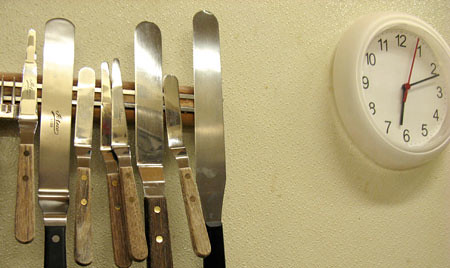
Most days are pretty good. I look at the clock constantly, checking my progress. Each time I look, I have no idea what the time actually means. I know how many minutes a set of turns should take (Six, but if I get it down lower I am doing great!). I follow the patterns, thinking about where I can shave minutes, because that will give me just a little more time in case something comes up, a few more minutes just in case. The idea that a clock can tell me where I am in my workday just doesn't follow. Then, I pause, breathe, look at the clock and think, "Huh. That time already? Two hours? How did that happen?"

I know how it happened, of course. I was watching the clock the whole time.

Monday, January 19, 2009

Perspective

The people working to put food out in the Washington, DC area right now? (I'm including servers and chefs, dishwashers, linehogs, bakers, baristas, bartenders, purveyors, hell even the delivery truck drivers. Especially delivery truck drivers.) Those are the people who seriously deserve respect and admiration. I mean, imagine you run a bakery, a good one, and on the average Tuesday you go through, say, 88 pounds of butter. Now imagine that your city's population is expected to quintuple almost overnight, stay that way for a few days and then return to normal. How much butter should you buy? How much product do you make? How do you make sure that your retail staff doesn't collapse with exhaustion before 9 am and still can manage a smile at 10? How do you deal with a dairy company that has every single one of its clients dealing with the same problems you have? How do you make sure your staff can even get to work?

I have images of prep cooks all over that city catching catnaps on sacks of flour. Servers who turn the corner and break out in sobs. Chefs standing at the pass reciting the Saint Crispen's Day speech from Henry V.

Ok maybe not, but it would be appropriate, "Then he will strip his sleeves and show his scars and say These wounds I had on Inauguration Day".

Take care out there, ok?

And if you're in the DC area as one of the many witnesses to tomorrow's inauguration? Tip well.
OK, Tip well anyway, but you know what I mean.

Sunday, January 11, 2009

The Problems with Good Bread

1. It's time intensive.

2. Basic cost of goods is relatively cheap, and everyone knows it, so you can't charge enough to make much of a sustainable living off bread alone.

3. It has a very, very short shelf life. And you had better be able to come up with something to do with the leftovers when you have them.

4. The labor to make 15 loaves and 25 loves is similar, but you need to have something you can do with the other ten loaves, see #3.

5. Once you start feeding the bitch, you can't stop. It needs feeding at regular times, gets finicky about the day, the time, even the weather. And even if you are nice to it, there is no guarantee that your bread will be as nice today as it was yesterday. And if the bitch dies, it takes a while to get a new one going again. (Don't ask me what happened to the employee who threw away all the levain one morning.)

6. It requires special equipment. Not that a spiral mixer or a deck oven can't be used for other things, but for really good bread, that's thousands of extra dollars.

7. Every baker knows these things. They also know that there are wholesalers that they can just buy bread from and with everything else, it would just be so, so easy....

8. Everyone wants it. Why is this a liability? If you make enough to fill the need, it tends to be a dedicate your life to it or let it go choice. In this industry, which do you think works best for most small bakeries?

Scary list for a bread geek like me.

Find a bakery. If they make their own bread - and I said "make" not "bake" - start buying it. This is an affordable luxury even just once a week, and I don't think I need to list all the reasons why good bread is better than the preserved flour sponges that sell at the big chains. It's better than the "artisanal bread" from those same grocery chains because you know who made it, and can ask all the necessary questions, like, "Has this been frozen?". If the baker looks affronted at the thought, buy the bread.

I mean, look at the crust on this. I make good bread, but this? Totally worth $3.50.